Stop patient gagging with this simple tool: Acupressure
Key Highlights
- Ren-24 (Chengjiang, CV24) sits in the mentolabial groove and is classified as the crossing point of the conception vessel with the stomach channel, which is a single, shallow, low-risk point that both classical texts and modern clinical trials tie to reflex suppression in the perioral region.
- A gagging patient during a dental procedure is not a compliance problem; it is a vagally mediated reflex arc, and that same reflex is implicated in one of dentistry's more preventable complications: aspiration or ingestion of a small dental instrument.
- Four independent clinical investigations spanning cardiology, anesthesia, and dentistry report that needling CV24 reduces gag severity versus sham or no treatment, though the dental-specific evidence remains case reported.
- Needling depth is inconsistently reported at 0.2 to 0.3 cun (.5 cm) in some manuals, 0.3 to 0.5 cun in others.
- Needle-free alternatives exist: acupressure at CV24 itself or a stick-on magnetic patch at the wrist point PC6 (Neiguan) extend a comparable reflex-dampening effect to needle-averse patients.
An underused point for an overmanaged problem
Ask most clinicians how they handle a patient who gags the moment a file, cotton roll, or impression tray crosses the soft palate, and the answer is almost always behavioral: reassurance, distraction, topical anesthetic on the palate, breathing cues, or when none of that works, sedation. What almost never comes up is a needle placed a few (3-5) millimeters deep in the crease between the lower lip and the chin. That gap in the conversation is worth closing, because the point in question, Ren-24, has a body of clinical evidence behind it that most restorative and surgical dentists have simply never been shown.
The point: Location, classification, and function
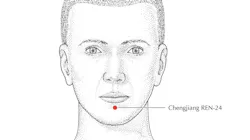
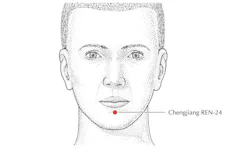
Ren-24, known in Chinese as Chengjiang, which literally means “container of fluids,” is the terminal point of the conception vessel (Ren Mai). Classical acupuncture sources classify it as a crossing point, the location where the Ren channel meets the stomach and large intestine channels, which is the anatomical basis for its broad perioral indications.1 It is located on the face in the small depression at the center of the mentolabial groove, the horizontal dip midway between the lower lip and the point of the chin (figure 1).
Traditional indications cluster tightly around the lower face and mouth: facial paralysis and Bell’s palsy, mouth twitching, lower-lip and chin numbness, toothache, gingival swelling and pain, oral ulceration, and disorders of salivary control, from drooling and dribbling to dry mouth. The needling technique is oblique, angled superiorly toward the lower lip. Depth is where sources diverge: some list 0.2 to 0.3 cun, others 0.3 to 0.5 cun. A cun, or “body inch,” is a patient-specific unit, commonly taken as the width of the patient’s own thumb at the interphalangeal crease. Given the disparity in the literature, the conservative choice for any clinician using this point adjunctively is to stay at the shallow end (about .5 cm).
What the evidence shows
The case for CV24 is not just anecdotal. In a blinded, randomized, controlled pilot trial of 41 patients undergoing transesophageal echocardiography, a single needle at CV24 produced significantly less gagging than both a superficial sham point (p = .037) and no treatment (p = .013), the strongest single demonstration to date of a point-specific effect rather than a generalized placebo response.2
In a separate randomized trial, 45 volunteers tolerating a Berman oral airway showed significantly reduced gag severity, longer tolerated duration, and a lower urge to gag with CV24 acupuncture versus control, though the sham group also improved, indicating a measurable placebo contribution alongside the specific effect.3
In dentistry specifically, a clinical audit of patients whose severe gag reflex complicated upper alginate impressions found that CV24 needling moderated the reflex in the majority of cases, reducing it to a level that only mildly complicated treatment; the authors called for a randomized trial to confirm the finding.4
A registered, placebo-controlled protocol now pairs CV24 with bilateral PC6 at the wrist using indwelling intradermal needles for procedural gagging, the combination most commonly used in dental and procedural practice today.5 Taken together, the evidence spans three specialties and is consistent in direction, even if the dental-specific data remains limited with an acknowledged placebo component.
Technique in the chair
For patients who accept a needle, a brief preprocedure treatment at Chengjiang oblique insertion, superiorly directed, to a shallow depth of 0.2 to 0.3 cun. This technique takes less than a minute and can be performed immediately before rubber dam placement or impression-taking (see video). For needle-averse patients or for clinicians without acupuncture training on staff, manual acupressure at the same point, or a self-applied adhesive magnetic patch at PC6 on the wrist, offers a comparable, drug-free option that the patient can use unsupervised; randomized data on the P6 wristband show measurable improvements in nausea, retching, and comfort scores using exactly this needle-free format.6
Conclusion
Periodontists and endodontists spend a great deal of professional energy arguing that the mouth is not an isolated organ system and that the oral-systemic connection has consequences for cardiovascular and metabolic health. The gag reflex is a smaller, more immediate version of the same argument: it is a vagally mediated, whole-body reflex arc that clinicians have spent decades managing as though it were a personality trait. A single, well-studied point at the chin does not replace clinical judgment, sedation when it is genuinely indicated, or rubber dam isolation. It does mean that for the patient who gags at the sight of a dental instrument, the next step does not have to be a phone call to schedule sedation. It can be a needle, or a patch, at a point that has already been tested and found to work.
Frequently asked questions
How deep should the needle be placed?
Sources differ but 0.2 to 0.3 cun in some references and 0.3 to 0.5 cun in others. Given the shallow soft-tissue depth at this location, clinicians should default to the more conservative end of that range.
Does CV24 acupuncture eliminate the gag reflex in every patient?
No. The controlled trials show a statistically significant reduction in gag severity and frequency versus sham or control, not universal elimination, and at least one trial documented a measurable placebo response in the sham arm as well.
Is there a needle-free version of this technique?
Yes. Manual acupressure at CV24, or an adhesive magnetic patch at the wrist point PC6 (Neiguan), has randomized-trial support for reducing nausea and gag-related symptoms and can be self-applied by the patient.
Does this replace rubber dam isolation during endodontic treatment?
No. It is an adjunct that reduces the reflex driving the risk. Rubber dam isolation and standard instrument-securing protocol remain the standard of care for preventing aspiration or ingestion of endodontic files.
Author’s note: Special thanks to Richard Schwartz, a member of the International Association of Dental Specialists (IADS) who brought this technique to my attention during a forum discussion on this online association.
Editor’s note: This article originally appeared in Perio-Implant Advisory, a chairside resource for dentists and hygienists that focuses on periodontal- and implant-related issues. Read more articles and subscribe to the newsletter.
References
- Deadman P, Al-Khafaji Nm Baker K. A Manual of Acupuncture. 2nd ed. Journal of Chinese Medicine Publications; 2007.
- Rösler A, Otto B, Schreiber-Dietrich D, Steinmetz H, Kessler KR. Single-needle acupuncture alleviates gag reflex during transesophageal echocardiography: a blinded, randomized, controlled pilot trial. J Altern Complement Med. 2003;9(6):847-849. doi:10.1089/107555303771952190
- Mitchell J, Jeffrey S, Lochhead V. Use of acupuncture to reduce gagging during the insertion of an oral airway. Anaesthesia. 2008;63(12):1389-1390. doi:1111/j.1365-2044.2008.05645_4.x
- Rosted P, Bundgaard M, Fiske J, Pedersen AML. The use of acupuncture in controlling the gag reflex in patients requiring an upper alginate impression: an audit. Br Dent J. 2006;201(11):721-725. doi:10.1038/sj.bdj.4814305
- Usichenko TI, Müller-Kozarez I, Knigge S, Busch R, Busch M. Acupuncture for relief of gag reflex in patients undergoing transoesophageal echocardiography – a protocol for a randomized placebo-controlled trial. Medicines (Basel). 2020;7(4):17. doi:10.3390/medicines7040017
- Ünülü M, Kaya N. The effect of Neiguan point (P6) acupressure with wristband on postoperative nausea, vomiting, and comfort level: a randomized controlled study. J Perianesth Nurs. 2018;33(6):915-927. doi:10.1016/j.jopan.2017.09.006
About the Author
Tony Willcox, PhD, DAOM, AP
Tony Willcox, PhD, DAOM, AP, is a board-certified Doctor of Acupuncture and Oriental Medicine with a PhD from Anhui University of Chinese Medicine and 19-plus years of clinical experience. He is a published researcher in acupuncture for mild cognitive impairment, with a proven track record of enhancing athletic performance and recovery as the official acupuncturist for the NHL Florida Panthers and UFC Blackzilians. Dr. Willcox is dedicated to advancing holistic healing through continuous education and specialized techniques in Traditional Chinese Medicine (TCM).
 Scott Froum, DDS
Scott Froum, DDS
Editorial Director
Scott Froum, DDS, a graduate of the State University of New York, Stony Brook School of Dental Medicine, is a periodontist in private practice at 1110 2nd Avenue, Suite 305, New York City, New York. He is the editorial director of Perio-Implant Advisory and serves on the editorial advisory board of Dental Economics. Dr. Froum, a diplomate of both the American Academy of Periodontology and the American Academy of Osseointegration, is in the fellowship program at the American Academy of Anti-aging Medicine, and is a volunteer professor in the postgraduate periodontal program at SUNY Stony Brook School of Dental Medicine. He is a trained naturopath and is the scientific director of Meraki Integrative Functional Wellness Center. Contact him through his website at drscottfroum.com or (212) 751-8530.